On this page
Once your organisation is registered to deliver training to overseas students, you need to meet the obligations that apply to all CRICOS providers.
Annual registration charge
ASQA’s annual registration charge is payable by all ESOS registered providers. It is designed to recover the costs of ASQA’s regulatory activities.
If you are a new ESOS provider, your first invoice:
- will be issued on the first day of the first whole calendar month of your registration period
- will be based on the number of qualifications (including accredited courses) on your scope of registration on that date.
Read more about the Annual registration charge.
There are also charges relating to initial registration, see - Apply for registration.
Read more about how ASQA consults on fees and charges.
Use PRISMS to manage overseas student enrolment
The Provider Registration and International Student Management System (PRISMS) is an Australian Government secure online system that allows providers to issue confirmations of enrolment (CoEs).
Australian Government agencies use PRISMS to monitor student compliance with visa conditions and provider compliance with the Education Services for Overseas Students (ESOS) Act 2000.
ESOS providers need to:
- issue CoEs to overseas students intending to study in Australia (the Department of Home Affairs requires these to issue a student visa)
- report changes in course enrolment using PRISMS.
If you're a new ESOS provider, ASQA will contact you with information on how to access PRISMS once your application for registration is approved.
Meet the requirements under the Tuition Protection Service (TPS)
The Tuition Protection Service (TPS) helps to protect your overseas students if you are unable to deliver their course of study fully.
The TPS ensures that these students can either:
- complete their studies in another course or with another education provider or
- receive a refund of their unspent tuition fees
ESOS providers need to contribute annually to the TPS and meet other obligations outlined at tps.gov.au.
Registration of ESOS delivery locations
Providers may only deliver all or part of a course at a location approved for that course.
You need to be registered for a course at any location where your students undertake formal theory or practical training in that course, such as a classroom or a kitchen or automotive workshop. This includes any location operated by another organisation you’ve engaged under a third-party arrangement to deliver to your students.
You do not need to be registered for a course at any location where your students may undertake work experience that is not a formal component of their course. You also do not need to be registered for any location where your organisation hosts students who are enrolled with another provider, as a third-party agent of that provider.
This address is only for the purposes of registering a location for a course for an overseas student. This address will not be used to send any information to your organisation. Notices will always be sent to your organisation’s postal address, to the Principal Executive Officer (PEO), or your organisations identified primary contact, via email.
Location registration requirements are outlined under Section 8 of the ESOS Act 2000.
Commonly asked questions about ESOS delivery locations
No. A location can be defined as a campus location.
A location can be considered a campus where there are multiple buildings in the same geographical location. To be considered a campus, the buildings would need to be near to each other, but they may have different street addresses or be on opposite sides of a main road.
Two or more buildings that are not in close proximity to each other cannot be considered a campus.
Examples:
|
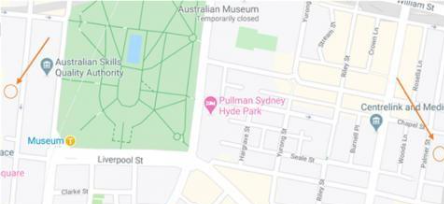
Example 1: not regarded as a single campus |
Explanation: In this example, 219 West St SYDNEY NSW 2000 and 208 East St SYDNEY NSW 2000 cannot be considered a single campus as the two buildings are not in close proximity to each other. In this example, there are multiple buildings between the two locations not owned or operated by the provider. |
|
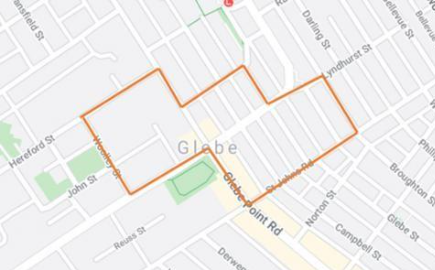
Example 2: regarded as a single campus |
Explanation: This is a location that would be considered to be a single campus. While some of these buildings may have a different street address, or are separated by a street, all buildings are in close proximity to each other. |
For a campus, only one street address is required.
For example:
For the campus Building A-Q & Z, 651-731 Stewart Street, Ultimo NSW 2007, the location would be registered as 651 Stewart St ULTIMO NSW 2007.
For all locations, including campuses, ASQA requires the following information:
- Floor level(s) of your organisation (if applicable)
- Street number
- Street name
- Suburb
- State
- Postcode
No, ASQA only requires:
- Floor level(s) of your organisation (if applicable)
- Street number
- Street name
- Suburb
- State
- Postcode
Some examples of information not required when registering a location include:
- shop
- unit
- business park
- name
- site
- wing
- gate
- office
- suite
- block
- hangar
- room
- tower.
Where a street address covers multiple lots, only the lower number of the range need to be entered. For example:
‘651-731 Harris Street, Ultimo NSW 2007’ would be entered into asqanet as ‘651 Harris Street, Ultimo NSW 2007’.
A single building will always be a single location, consistent with ASQA's current fees & charges. So, whether your organisation is a single room on a floor, multiple levels in a large building, or the whole building itself, you will only need to register the one location. However, if you are using more than one level of a location, it is important that you notify us of all levels that your organisation is using to provide courses to overseas students.
For example:
- Level 1, 256 Smith St SYDNEY 2000
- Level 3, 256 Smith St SYDNEY 2000
- Level 4, 256 Smith St SYDNEY 2000
Would be entered into asqanet as one location:
Level 1, 3, 4, 256 Smith St SYDNEY 2000.
If your organisation uses every floor of a 10-storey building, every level would still need to be entered into asqanet. For example:
Level 1, 2, 3, 4, 5, 6, 7, 8, 9, 10, 256 Smith St SYDNEY 2000
Related links
- ESOS framework
- Annual Registration charge
- Current fees & charges
- asqanet - ASQA’s online application and registration management system
- Education Services for Overseas Students (ESOS) Act 2000
- Education Services for Overseas Students Regulations 2019