On this page
Performance assessments
Part of ASQA's role as a regulator is to assess the performance practices of registered training organisations and Commonwealth Register of Institutions and Courses for Overseas Students (CRICOS) providers.
We assess the performance of providers to ensure they comply with the:
- Outcome Standards 2025
- National Code of Practice for Providers of Education and Training to Overseas Students 2018.
Performance assessments (audits) are one of the tools we use to understand training provider performance.
In 2026 we made changes to the way we conduct performance assessments. Our publication ASQA’s Regulatory Assessment and Monitoring Approach explains these changes.
Why we conduct performance assessments
We conduct performance assessments to ensure the integrity of training providers and the quality of training they deliver.
Performance assessments tell us if you’re compliant with the standards and legislation and give your students assurance that their education investment has value and purpose.
We may conduct a performance assessment if:
- we have data or information that indicates you may be at risk of not meeting your regulatory obligations (e.g. from a complaint or tip-off),
- as part of our environmental risk monitoring processes.
In all cases we conduct an initial appraisal before deciding whether to apply regulatory scrutiny through assessment in response to potential risk.
If we identify non-compliance during your performance assessment, our return to compliance focus gives you opportunities to respond and make improvements to rectify non-compliance.
What we assess
When we assess you, we’ll consider how you perform against the relevant standards and/or legislation.
Standards and legislation your performance is assessed against
For RTOs
National Vocational Education and Training Regulator Act 2011
- VET Quality Framework (inclusive of the 2025 Standards for RTOs)
For providers registered on CRICOs or ELICOS providers
Education Services for Overseas Students Act 2000 (ESOS Act)
- National Code of Practice for Providers of Education and Training to Overseas Students 2018
- ELICOS Standards 2018
How we scope your assessment
We take a sampling approach to performance assessments.
This means to understand your performance we will:
- usually look at some, but not all standards
- sample evidence across your training products and/or locations.
The standards and training products we sample as part of your performance assessment are known as the ‘scope’ of the assessment.
We decide the scope of your performance assessment and the standards and training products we intend to sample by reviewing both provider and sector risks. This includes reviewing things like:
- student enrolment and completion data
- compliance history
- current and past complaints or tip-offs
- intelligence from other regulators and agencies
- ASQA’s regulatory risk priorities
Performance assessment categories
ASQA uses a scaled approach to performance assessments to reflect differing levels of assessment effort and complexity. There are four categories, ranging from category 1 micro assessments (short, targeted checks) to category 4 (large-scale) performance assessments. Different charges apply to different performance assessment categories.
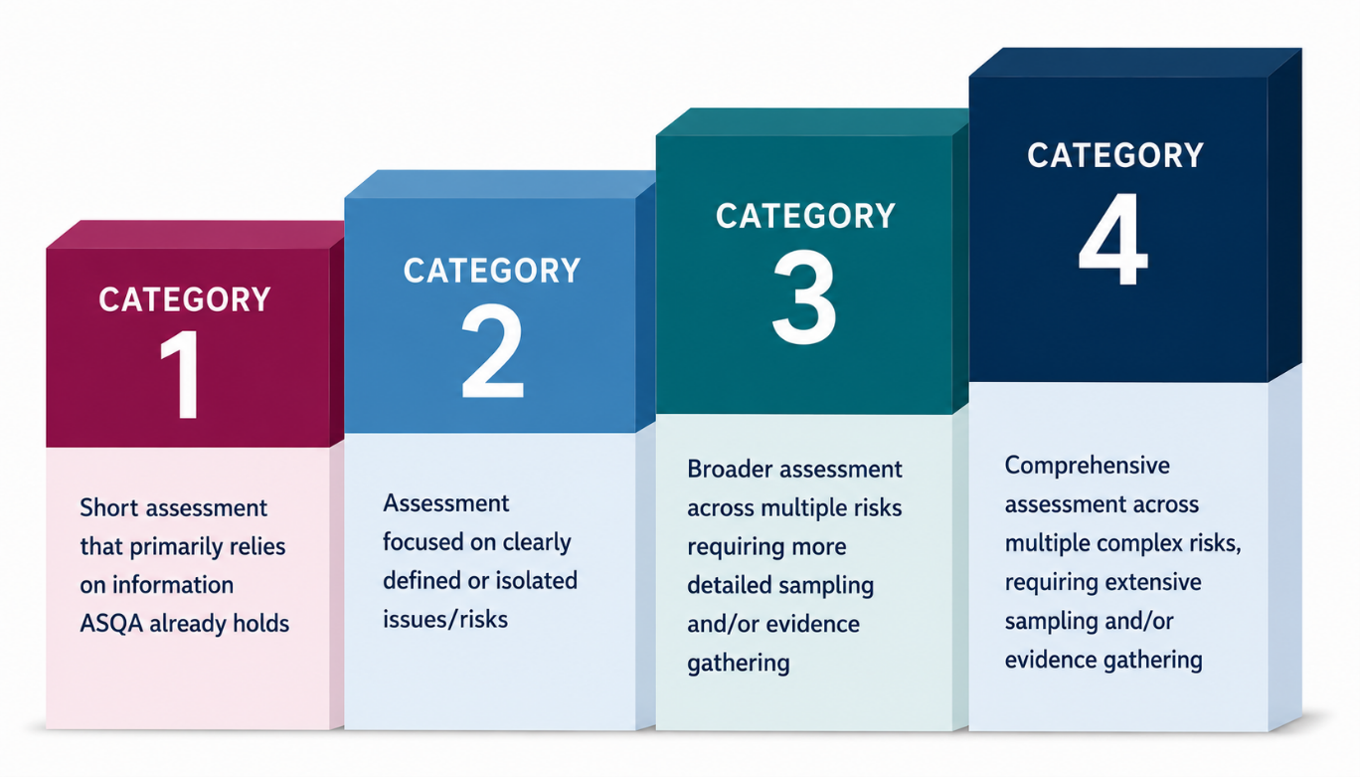
We will determine the appropriate performance assessment category based on:
- the number and nature of risks to be examined
- the training products to be sampled
- any delivery locations to be included
- the number of students to be interviewed
- the nature of any complaints, tip-offs or other concerns.
The performance assessment category is not based on the provider’s size. For example a larger provider may be subject to a Category 2 performance assessment, or a smaller provider may be subject to a Category 4 performance assessment.
You will be notified of your initial category and the associated cost at the commencement of a performance assessment.
If the scope of the performance assessment expands during the assessment, you will be notified that your performance assessment has moved up the scale and the costs will be adjusted accordingly.
The performance assessment process from start to finish
The performance assessment (audit) process includes 5 key steps, they include:
- we contact you and plan the scope of your performance assessment:
- we make initial contact with you
- we request preliminary information
- we plan the scope of the performance assessment
- we hold an opening meeting with you
- your compliance with the standards and legislation is tested by collecting and analysing evidence via:
- information requests via email
- virtual or onsite observations
- interviewing you, your trainers, assessors, students and others
- we hold a closing meeting to explain findings to date
- we write a performance assessment report that identifies compliance and non-compliance
- we share our findings with you and outline the next steps – this may include offering a 20-day rectification period to address non-compliances before finalising the assessment outcome.
Where non-compliance remains after the rectification period, the performance assessment is closed (and invoice issued), and you will commence on a Compliance Resolution Pathway.
Cost of a performance assessment
Charges are payable for conducting performance assessments.
The cost includes:
- planning and conducting and the performance assessment
- preparing the performance assessment report
- any other business process related to the performance assessment.