On this page
The rapid uptake of AI is reshaping aspects of vocational education and training (VET) delivery, with providers increasingly incorporating AI into administrative functions, teaching and learning activities, and assessment processes.
AI tools can interpret, analyse and generate information. They can work with complex or ambiguous inputs, for example, giving feedback on student writing, generating lesson materials or summarising student questions.
AI tools can sometimes be confused with automation tools. Automation tools follow predefined rules. They do the same task the same way every time. For example, automatically marking multiple‑choice questions is automation. There is no interpretation, learning or decision‑making beyond the rules that have been explicitly programmed.
Understanding this distinction is important when considering the implications of AI use in VET.
Risks and Opportunities
AI systems and tools present both risks and opportunities in the VET sector. They can enhance efficiency and innovation, but can also introduce risks relating to quality, integrity, accuracy, privacy and accountability. Some of the key risks and opportunities associated with AI use in VET are listed below.
|
Risks |
Opportunities |
|
|
Principles for the Responsible Use of AI in VET
ASQA’s Principles for the Responsible Use of AI in VET aim to guide providers towards safe, ethical and effective use of AI. The principles do not introduce new regulatory requirements – rather, they provide a structured way to interpret, implement and oversee AI use within providers’ existing obligations, including the 2025 Standards for RTOs.
The 5 principles:
- AI use is supported by strong governance that ensures it does not undermine the quality or integrity of VET.
- Human oversight and accountability is maintained in all AI supported activities, ensuring that decisions affecting students remain the responsibility of qualified trainers, assessors and staff.
- AI systems and tools manage information securely and in accordance with existing privacy, data protection and record keeping obligations.
- AI use supports and enhances student equity, inclusivity, accessibility and wellbeing.
- AI use aligns with training product requirements, industry expectations and the needs of the relevant student cohort.
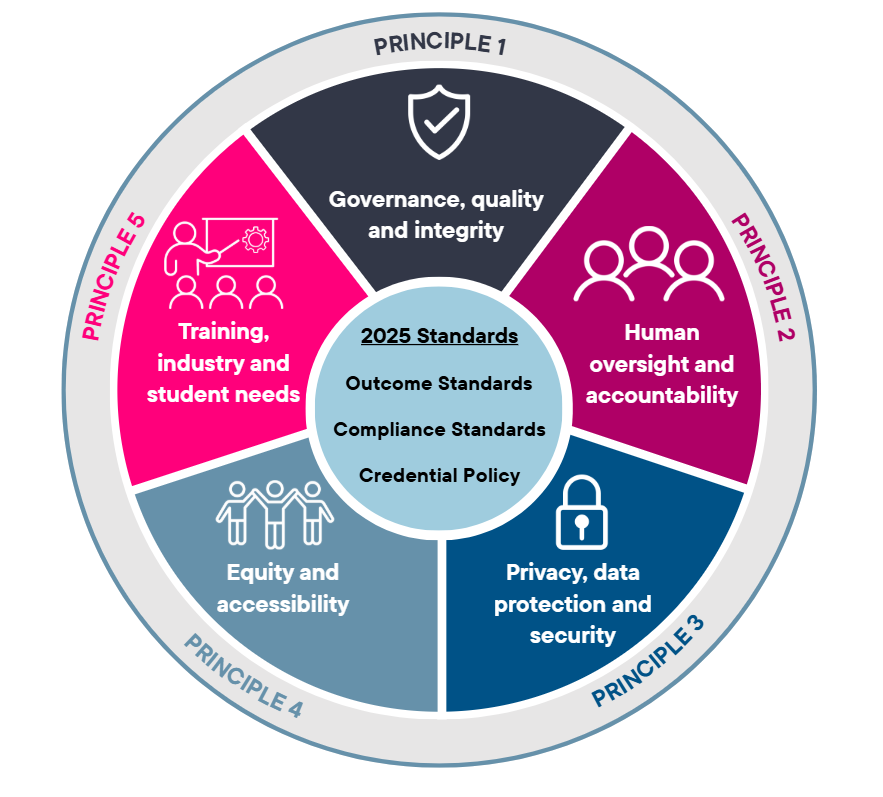
Understanding the principles
Description
AI must be used in ways that protect the quality and integrity of VET through strong provider governance, processes and controls that support compliant and reliable practices. Providers’ governance arrangements should ensure that:
- AI use is understood, managed and applied in a purposeful way
- visibility of how AI is used in training and assessment practices is maintained
- systems for identifying and responding to AI risks are implemented
- AI adoption is carefully considered and incorporated into organisational processes without undermining the quality or integrity of VET delivery or outcomes.
Self-assurance questions
- Which roles will be responsible and accountable for how AI is used and overseen across your organisation? Do these individuals need to be upskilled in order to fulfill their responsibilities?
- What policies, frameworks and controls are needed to guide how AI tools and systems are selected, implemented and used across your organisation?
- What risks are associated with your chosen AI tools and systems, and how will they be mitigated/ managed?
- How will you ensure that your AI use does not compromise the integrity of training and assessment practices, and that outcomes reflect a student’s own skills, knowledge and competencies?
- How and when will you actively monitor and evaluate your AI systems and tools to ensure they operate as intended?
Relevant Standards
- Quality Area 4 - Governance - Standard 4.1
- Compliance Requirements - Clause 9
Description
Providers must ensure that qualified trainers, assessors and staff retain full responsibility for decisions affecting students and apply active human oversight and professional judgement to all AI supported activities. AI must not replace human decision-making, evaluation or accountability. This means AI outputs are considered, reviewed and applied in context, rather than relied on without scrutiny. Staff remain responsible for determining the appropriateness, accuracy and relevance of AI supported processes and outcomes, particularly where decisions may impact student progression, assessment or support. Responsibility for decisions rests with qualified personnel, and the use of AI must not diminish professional accountability.
Self-assurance questions
- Do your staff have sufficient understanding of your organisation’s policies on AI use to apply them in their day-to-day role? For example, would your staff recognise when AI outputs are incomplete, inaccurate or not fit-for-purpose?
- Who will be responsible for ensuring that all AI supported outputs are reviewed, tailored and verified before being used in a training or assessment context
- How will you know if your staff are misusing AI, for example, relying solely on AI to make decisions such as assessment judgements?
- How will you make students aware of the AI tools and systems you use in your registered training organisation (RTO)?
Relevant Standards
- Quality Area 1 - Training and assessment - Standard 1.4
- Quality Area 3 - VET workforce - Standards 3.2 and 3.3
- Quality Area 4 - Governance - Standard 4.2
Description
AI must be used lawfully and in accordance with providers’ privacy, security and data-handling obligations. This includes understanding how AI systems and tools collect, use, store and share information, and ensuring that their use does not result in the inappropriate disclosure or misuse of personal or organisational data. Where an off-the-shelf AI tool or system is being used, providers remain responsible for undertaking due diligence to ensure student privacy and security is able to be maintained.
Self-assurance questions
- Does your Student Management System and/or Learner Management System have inbuilt AI capabilities? If so, what are the risks associated with this and how will they be managed? For example, have you considered data sovereignty and if data is stored onshore or offshore?
- Do your staff understand what information can and cannot be shared with AI tools, particularly where personal or sensitive data is involved?
- How will you advise students, and gain their prior written consent, when their personal or sensitive information may be used in, or processed by, an AI-enabled system or software solution?
- If your AI systems create records, how will you ensure they are retained in accordance with record keeping requirements?
Relevant Standards
- Quality Area 4 - Governance - Standards 4.1 and 4.3
- Compliance Requirements - Clause 20
Description
Providers must ensure that their AI use is fair and transparent, and does not create barriers to equitable, inclusive and accessible learning experiences. This includes for students with diverse backgrounds, abilities, digital literacy levels and support needs. Providers need to consider how different students may experience and engage with AI supported activities, including their access to technology, confidence in using digital tools and ability to participate effectively. AI use should support participation, enhance accessibility and contribute to student wellbeing, rather than create additional complexity.
Self-assurance questions
- How might your AI systems and tools affect student engagement and participation, both positively and negatively?
- How will you ensure equitable access by all students to your AI tools and systems?
- What student support can you offer to ensure that AI tools and systems can be used with confidence, especially for those with low digital literacy?
- Are your AI systems and tools appropriate for your student cohort? For example, are they capable of considering diverse perspectives and cultural sensitivities?
- How will you ensure that AI use does not create reliance on technology or tools, putting academic integrity at risk?
Relevant Standards
- Quality Area 2 - VET student support - Standards 2.2 to 2.6
Description
AI use must not compromise the requirements of the training product, including the conditions under which competency is to be achieved and demonstrated. AI use must be suitable for the student cohort and context, supporting learning and participation without undermining the development and demonstration of required skills and knowledge. All training product requirements must be met where AI is used, regardless of whether AI is explicitly referenced in the training product. AI use should also reflect industry and workplace expectations.
Self-assurance questions
- How will you ensure your use of AI supports, and does not dilute, students’ development of skills and knowledge as required by the training product?
- How will you keep pace with industry’s adoption of AI in relation to the courses you have on scope? What professional development will your trainers and assessors need to maintain industry currency?
- What existing training and assessment practices need to be maintained/are not suitable to be conducted using AI?
Relevant Standards (2025 Standards for RTOs)
- Quality Area 1 - Training and assessment - Standards 1.1, 1.2 and 1.3
- Quality Area 2 - VET student support - Standard 2.2
Useful resources
- Australia’s AI Ethics Principles | Department of Industry Science and Resources
- Gen AI knowledge hub | Tertiary Education Quality and Standards Agency
- Australian Framework for Generative Artificial Intelligence (AI) in Schools - Department of Education, Australian Government
- Practice guides | Australian Skills Quality Authority